
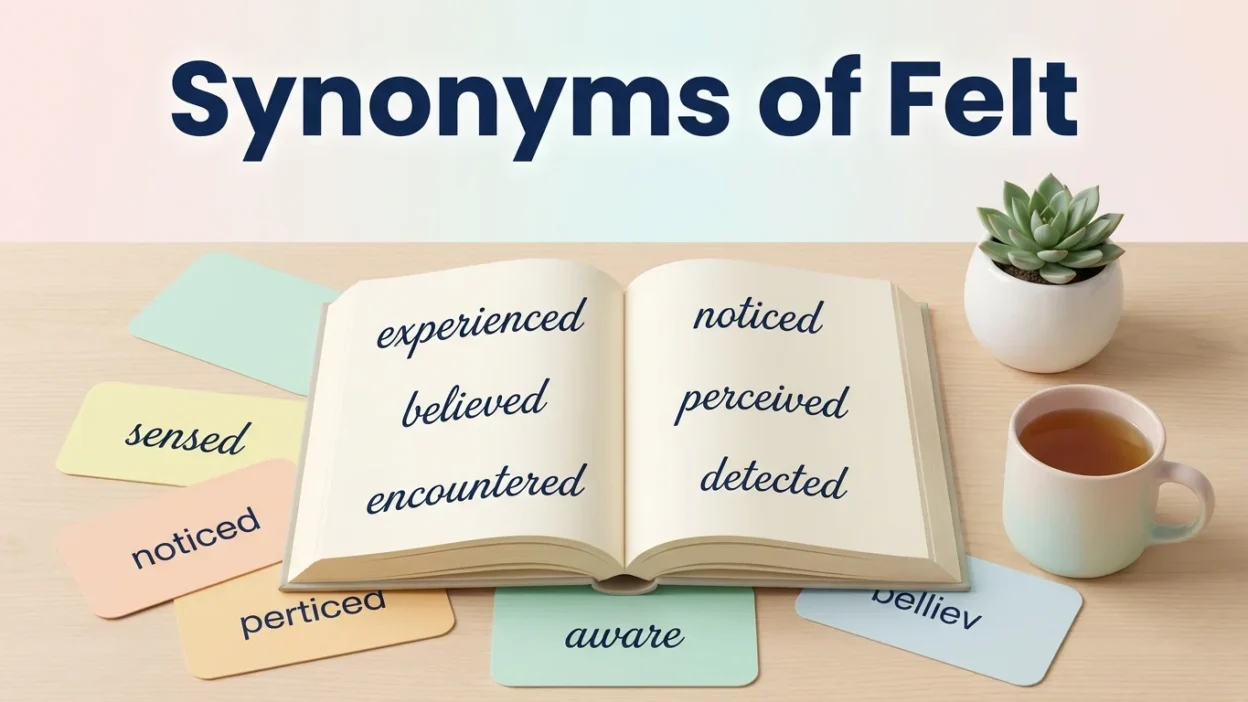
The word “felt” is commonly used to describe emotions, physical sensations, and personal experiences. However, using the same word repeatedly can make your writing sound less varied. Learning synonyms of felt can help you express feelings, describe experiences, and communicate ideas more clearly.
Whether you are a student, ESL learner, writer, or content creator, understanding alternatives to “felt” can improve your vocabulary and make your sentences more engaging. The best synonym depends on what you want to express, such as an emotion, a physical sensation, or an opinion.
In this guide, you will discover 30 synonyms and related alternatives for “felt,” along with simple meanings, example sentences, and tips for choosing the right word.
• What Does “Felt” Mean?
“Felt” is the past tense and past participle of the verb “feel.” It can describe experiencing an emotion, noticing a physical sensation, or having an opinion about something.
For example:
- Emotion: She felt happy after hearing the news.
- Physical sensation: He felt a cold breeze on his face.
- Opinion: I felt that the decision was unfair.
- Empathy: She felt sympathy for her friend.
“Felt” can also refer to a type of fabric made from compressed fibers. In that context, its alternatives are different from those used for emotions and sensations.
• 30 Synonyms and Alternatives for Felt
The following words are useful alternatives in different contexts. Some are direct substitutes in particular sentences, while others express a related meaning.
• Synonyms for Felt When Describing Emotions
1. Experienced
Meaning: Went through an emotion, event, or situation.
Example: She experienced great joy when she graduated.
Best usage: Formal writing and descriptions of personal experiences.
2. Experienced emotionally
Meaning: Went through a particular emotional state.
Example: He experienced sadness after saying goodbye.
Best usage: Explaining emotional reactions clearly.
3. Sensed
Meaning: Became aware of something through intuition or perception.
Example: She sensed tension in the room.
Best usage: Describing an impression or something noticed indirectly.
4. Perceived
Meaning: Became aware of or understood something in a particular way.
Example: He perceived the comment as criticism.
Best usage: Academic, professional, and analytical writing.
5. Underwent
Meaning: Went through a process or difficult experience.
Example: She underwent a period of emotional stress.
Best usage: Formal writing about challenging experiences.
6. Endured
Meaning: Suffered through something difficult over time.
Example: They endured months of uncertainty.
Best usage: Describing hardship rather than ordinary emotions.
7. Suffered
Meaning: Experienced pain, distress, or hardship.
Example: He suffered considerable disappointment.
Best usage: Serious or painful experiences.
8. Enjoyed
Meaning: Experienced pleasure or satisfaction.
Example: We enjoyed a wonderful evening together.
Best usage: Positive experiences; it does not replace “felt” in every sentence.
9. Relished
Meaning: Enjoyed something greatly.
Example: She relished the opportunity to perform.
Best usage: Strong enjoyment or enthusiasm.
10. Experienced emotionally
Meaning: Felt an emotional effect from an event or situation.
Example: The audience experienced emotional relief at the ending.
Best usage: Describing emotional responses in reflective writing.
• Synonyms for Felt When Describing Physical Sensations
11. Sensed
Meaning: Noticed something through the senses.
Example: He sensed a slight vibration in the floor.
Best usage: Physical sensations or subtle changes.
12. Detected
Meaning: Noticed the presence of something.
Example: She detected a faint smell of smoke.
Best usage: Scientific, technical, or precise descriptions.
13. Noticed
Meaning: Became aware of something.
Example: I noticed the cold air against my skin.
Best usage: Everyday writing and conversation.
14. Perceived
Meaning: Became aware of a sensation or stimulus.
Example: The patient perceived a slight change in temperature.
Best usage: Formal or scientific contexts.
15. Experienced
Meaning: Had a particular physical sensation.
Example: He experienced a sharp pain in his shoulder.
Best usage: Medical descriptions and personal accounts.
16. Registered
Meaning: Became noticeable to the senses or mind.
Example: She barely registered the cold because she was distracted.
Best usage: Describing whether a sensation or event was noticed.
17. Detected physically
Meaning: Noticed a physical sign or sensation.
Example: The device detected movement nearby.
Best usage: Technical descriptions; use “detected” when a person or device identifies something.
• Synonyms for Felt When Describing Opinions or Beliefs
18. Thought
Meaning: Had an opinion or idea.
Example: I thought the film was excellent.
Best usage: Everyday language and informal writing.
19. Believed
Meaning: Accepted something as true or likely.
Example: She believed the plan would succeed.
Best usage: Opinions, convictions, and assumptions.
20. Considered
Meaning: Thought about something or judged it in a particular way.
Example: He considered the decision unfair.
Best usage: Formal writing and careful evaluation.
21. Judged
Meaning: Formed an opinion about something.
Example: The committee judged the proposal unsuitable.
Best usage: Evaluations and decisions.
22. Assumed
Meaning: Accepted something as true without complete proof.
Example: I assumed that everyone understood the instructions.
Best usage: Situations involving expectations or unverified ideas.
23. Suspected
Meaning: Believed something might be true without being certain.
Example: She suspected that something was wrong.
Best usage: Uncertainty or intuition.
24. Concluded
Meaning: Reached a decision or opinion after considering information.
Example: We concluded that the first option was better.
Best usage: Reasoned judgments and academic writing.
• Synonyms for Felt When Describing Empathy or Reactions
25. Sympathized
Meaning: Shared or understood another person’s distress.
Example: I sympathized with her after the difficult experience.
Best usage: Showing concern for someone’s problems.
26. Empathized
Meaning: Understood or shared another person’s feelings.
Example: He empathized with his friend’s anxiety.
Best usage: Emotional understanding and supportive communication.
27. Related
Meaning: Understood someone’s experience because it was familiar.
Example: I related to her struggles at school.
Best usage: Connecting with another person’s experiences.
28. Responded
Meaning: Reacted to a person, event, or situation.
Example: She responded with relief when she heard the news.
Best usage: Describing an observable reaction rather than an internal feeling alone.
29. Reacted
Meaning: Behaved or experienced an emotional response because of something.
Example: He reacted with surprise to the announcement.
Best usage: Describing immediate emotional or physical responses.
30. Experienced deeply
Meaning: Felt something strongly or intensely.
Example: She experienced deep gratitude for their support.
Best usage: Reflective or expressive writing; this is a phrase rather than a single-word synonym.
• Comparison Table of Synonyms for Felt
| Synonym | Main meaning | Best context |
|---|---|---|
| Experienced | Went through something | Emotions and events |
| Sensed | Became aware of something | Intuition and sensations |
| Perceived | Became aware or interpreted | Formal and academic writing |
| Noticed | Became aware of something | Everyday situations |
| Thought | Had an opinion | Casual conversation |
| Believed | Accepted as true | Opinions and convictions |
| Considered | Judged or thought about | Formal writing |
| Suspected | Thought something might be true | Uncertainty |
| Sympathized | Shared concern | Emotional support |
| Empathized | Understood another’s feelings | Personal relationships |
| Relished | Enjoyed greatly | Positive experiences |
| Endured | Went through hardship | Difficult experiences |
| Reacted | Responded to something | Immediate responses |
| Concluded | Reached a judgment | Reasoning and analysis |
| Detected | Identified something | Sensory or technical contexts |
• Examples of Felt Synonyms in Sentences
Here are examples showing how different alternatives can work in context.
- Original: She felt nervous before the interview.
- Alternative: She experienced anxiety before the interview.
- Original: I felt that the answer was incorrect.
- Alternative: I believed that the answer was incorrect.
- Original: He felt a sudden movement.
- Alternative: He sensed a sudden movement.
- Original: She felt sorry for the injured animal.
- Alternative: She sympathized with the injured animal’s suffering.
- Original: They felt happy about the result.
- Alternative: They experienced happiness about the result.
Remember that a synonym does not always fit every sentence. Choose the word that preserves the original meaning.
• How to Choose the Right Synonym for Felt
Choosing the right synonym becomes easier when you identify the meaning of “felt” in your sentence.
For emotions: Use experienced, sensed, or endured, depending on the feeling and situation.
Example: She experienced relief after the exam.
For physical sensations: Use noticed, sensed, or detected.
Example: He noticed a strange sensation in his hand.
For opinions: Use thought, believed, or considered.
Example: I considered the suggestion helpful.
For empathy: Use sympathized, empathized, or related.
Example: She empathized with her colleague’s concerns.
For strong enjoyment: Use relished or enjoyed.
Example: He relished the chance to learn something new.
• Common Mistakes When Using Synonyms of Felt
Using words that change the meaning: “Thought” expresses an idea or opinion, while “sensed” often refers to awareness or intuition.
Using formal words in casual writing: “Perceived” may sound overly formal in an everyday conversation where “noticed” would be more natural.
Confusing empathy with sympathy: “Empathized” emphasizes understanding another person’s feelings, while “sympathized” often emphasizes concern for their situation.
Replacing every use of felt: Sometimes “felt” is the clearest and most natural choice. Synonyms should improve your writing, not make it unnecessarily complicated.
Ignoring grammar: “Felt” may describe an emotion, sensation, or opinion. Make sure the alternative fits the sentence structure.
• Final Thoughts
Learning synonyms of felt can make your writing more expressive and precise. Words such as experienced, sensed, noticed, believed, and empathized each communicate a slightly different meaning.
The best choice depends on whether you are describing an emotion, physical sensation, opinion, or reaction to another person’s experience.
Instead of replacing “felt” automatically, consider the message you want to communicate. With practice, you can choose more natural words, avoid repetition, and make your writing clearer for every reader.

Maximilian Octavian is a skilled SEO content writer and digital publishing specialist with a passion for producing accurate, engaging, and search-optimized content. He specializes in transforming in-depth research into clear, informative articles that resonate with readers across diverse industries. His work is guided by strong editorial standards, factual accuracy, and modern SEO strategies. Maximilian is dedicated to creating high-quality content that builds credibility, enhances visibility, and delivers lasting value.